
You're Not Overreacting. You're Under-Resourced.

Often when you reach out for therapy, you feel like something is wrong with you. You feel like you're overreacting, and that feeling can be a reflection of being in an unhealthy relationship. It can also be a reflection of something quieter and more common than that. What's actually happening, more often than not, is a state of overwhelm, one that's been building for longer than you've let yourself notice.
What overreacting usually is
When you don't have enough support, you feel incapable of keeping up with life's demands. This looks like burnout in your relationships and in your work. It looks like an inability to function at the level you used to, the level that once felt effortless. You become irritable and angry over things that never used to bother you. You feel like you plain can't cope with life in general, and that feeling itself starts to feel like proof that something is fundamentally wrong with you.
It isn't. Overreacting is rarely about the trigger in front of you. It's about how much you were already carrying before that trigger showed up.
Where it's coming from
Feeling like you're overreacting can be a reflection of what other people are telling you, directly or indirectly, over time. It can also be a reflection of having too many commitments and saying yes to obligations when you should be saying no. You know this is happening when you're not getting enough sleep, not getting enough exercise, and not connecting with the people and activities you enjoy. This is the primary way you know you're in a state of overwhelm and you need resourcing.
It's worth sitting with that word for a moment. Resourcing isn't the same as self-care in the way that phrase gets used online. It isn't a bath or a candle. It's the deeper, ongoing work of making sure you have enough support, connection, and rest built into your life that you aren't running on empty by the time anything hard actually happens.
What resourcing actually means
You need other people. You need to be in supportive relationships where you can both give and take. A relationship where your only role is to make the other person happy or to avoid their conflict becomes deeply unbalanced, and that imbalance takes far more out of you than it looks like from the outside. You need relationships in which you can both talk and listen, where support moves in both directions instead of just one.
When someone reflects it back to you
If a friend or loved one in your life notices patterns that are unhealthy and reflects that back to you, listen, and take it in. It's easy to become blind to the dynamics of the relationships you're in, especially the ones you've been in the longest. You can lose yourself completely in making a relationship work, to the point where you no longer notice you're doing it. This is the classic definition of codependence, and it's more common, and more quietly damaging, than most people realize.
Reattaching to your gut
Over time, in unhealthy relationships, you lose your sense of what's right, what's fair, and what's good for you. You override your gut so often that its signal starts to feel unreliable, even though it never actually was. You often have it reflected to you that the problems in the relationship are entirely your fault, and after enough repetition, you start to believe it. Reattaching to your gut means learning to listen to it again, noticing what your body is telling you when you're being told you're overreacting, and trusting that signal even before you can fully explain it.
Signs you're not overreacting
Codependence rarely looks like a single dramatic moment. It tends to build quietly, one small accommodation at a time, until the shape of your life has changed without your full consent. These are some of the clearest signs it's at play:
A deep need for approval
Extreme discomfort with someone else's anger or disapproval
Apologizing frequently, even when you haven't done anything wrong
Losing your own needs and desires
Guilt when you do something for yourself
Idealizing your partner and dismissing warning signs
Making excuses for someone's behavior
Saying yes to everything and taking on too much
No time left for yourself
A sense of loss of self
These are classic symptoms that you're not overreacting. You're losing yourself in an unhealthy relationship, one accommodation at a time.
What being well-resourced looks like
Being well-resourced means having breadth and depth in your connections and in your daily activities, ones that reflect who you are as an individual outside of any one relationship. It means having people in your life who know you outside of your role as a partner, a parent, or a peacekeeper. Therapy is one way to build this, because it creates a dedicated focus on you: what you want, what you need, and what you want to accomplish in your life, separate from anyone else's expectations of you.
Not every relationship gets to stay
Not everyone understands what it's like to feel challenged in a relationship. If there are relationships you've maintained over time that you find less than helpful, less than encouraging, less than supportive, those are relationships worth naming as limiting. The work is resourcing yourself with relationships that are positive, encouraging, and fulfilling, and being honest about which relationships in your life are actually doing that for you.
You're not too much. You're not overreacting. You're under-resourced, and that's something you can build back.
If this is resonating
A lot of this work starts with boundaries, and boundaries are often the hardest part to hold, especially if you've spent years worried about disappointing the people around you. My free guide, Boundaries Without the Guilt, walks through why boundaries feel so hard and how to start setting them in a way that feels steady, honest, and true to you.
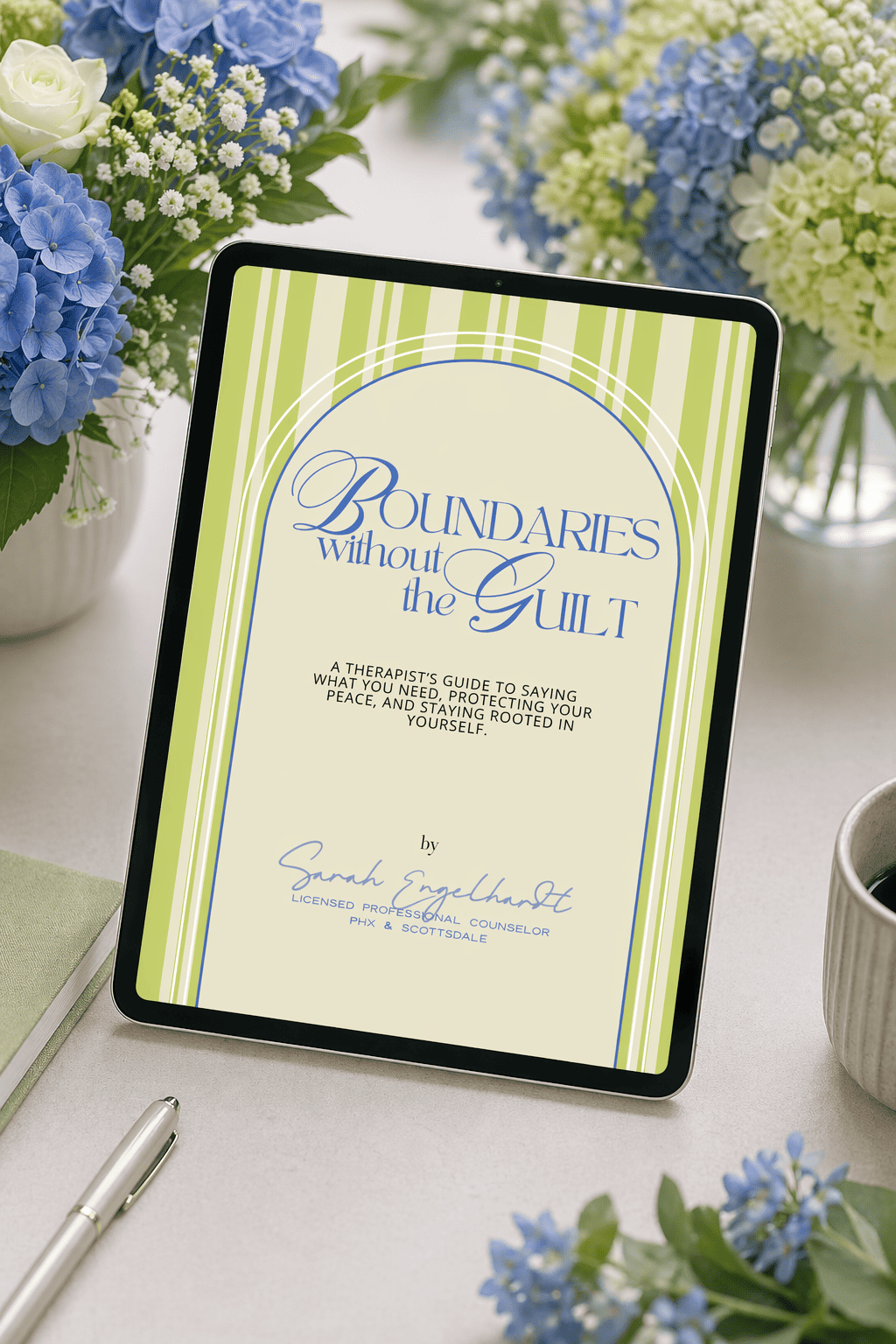
If you're ready to talk through what's been feeling like too much, I'd love to sit down with you and figure out where to start.
