
You Don't Need a Narcissist Diagnosis to Know a Relationship Isn't Safe

If you've spent any time up late scrolling "signs you're dealing with a narcissist," you already know how it goes. One list leads to another. You screenshot a text and send it to a friend with "does this feel off to you or is it just me." You start collecting evidence, half hoping you'll find the one article that finally explains what's happening in your relationship, as if the right word will be the thing that finally makes it real.
Here's what I want to offer instead: you don't actually need the word to know something isn't working. Your nervous system is what tells you when you are unsafe, and this is especially true in a relationship with someone who is narcissistic. That kind of relationship is confusing because what the other person says is happening and what is actually happening are two completely different things. You cannot always trust the words, so you rely on your nervous system and your somatic sense to tell you whether a situation is safe. That reliance isn't a weakness. It's often the most accurate information you have.
Your body is already doing the work
This is where your body picks up what your mind cannot untangle on its own. Somebody is speaking to you and telling you that what you're saying isn't true. Your heart rate climbs. You feel tension in your chest. You feel a pull to flee the situation entirely. Your body is telling you more than your cognitive system is, because your cognitive mind is busy taking in the words and treating them as absolute truth.
This is one of the hardest parts to explain to someone who hasn't lived it. From the outside, the conversation might look calm. Nothing dramatic happened. No one raised their voice. And yet your whole system is bracing, because your body has learned something your mind hasn't caught up to yet. Learning to trust that signal, instead of talking yourself out of it, is often where the real work begins.
Why it feels so confusing
You'll likely notice yourself walking on eggshells. You start catering your behavior to reduce potential conflict. That's often because the other person has to be right and lacks the self-awareness to sit with a different version of events. When you try to reflect your own experience and your own truth, it isn't accepted, and you continue to feel stress around the interaction. This is why you learn to rely on your somatic sense rather than the conversation itself.
You'll notice yourself changing your behavior in small, almost automatic ways. You start to acquiesce. You stop bringing up topics you know will be triggering. You get defensive, explaining yourself and building a case for why you're right, hoping that if you just find the right words, they'll finally understand. In every one of these moments, your body is already telling you something isn't right about the situation. The work is learning to listen to it instead of trying to out-argue it.
The pursuit and withdrawal cycle
Being with someone like this is highly disconnecting. As you try to connect or make your point known, they move further away. They use avoidance. They use defense tactics. They become emotionally distant. When this happens, you feel compelled to pursue, to make your point again, to get them to believe what you're saying. The more you do that, the further away they move.
This creates anxiety, tension, and restlessness, along with a strong desire to reconnect. The more you ask for those things, the harder they pull away, and their withdrawal increases your activation. It becomes a cycle of pursuit and avoidance, one that can repeat itself for years without either person naming what's happening. One of the most useful ways to interrupt this cycle is called gray rocking: limiting your responses, staying brief and to the point, keeping your tone flat so you're no longer feeding the push and pull. It isn't about giving up on connection. It's about protecting your own nervous system while you figure out your next step.
What this can cost you over time
Part of this work is building your own self-awareness around how you've adapted to a relationship like this. Depression. Anxiety. Anger. Social isolation. Dissociation. Flashbacks and nightmares. A fixation on the other person's behavior. Destructive or addictive coping. Moments where you just want it all to be over. These symptoms are what we call complex PTSD, and they can develop after time spent in a relationship like this.
None of this means something is wrong with you as a person. It means your system has been adapting, day after day, to an environment that never quite felt stable. Those adaptations made sense at the time. They kept you functioning. But they also come at a cost, and naming that cost is often the first step toward finding your way back to yourself.
Guilt becomes shame
All of this is reason enough to know a relationship is unsafe, even with no diagnosis for the other person. You'll feel an extreme sense of responsibility for the fact that the relationship isn't going well. Guilt shows up first, telling you that you did something wrong. Shame moves in behind it, telling you that you are wrong, because of the dynamics of the relationship itself.
That shift from guilt to shame is subtle, and it's part of what keeps people staying far longer than they ever intended to. Guilt can be addressed. You can apologize, adjust, and move forward. Shame doesn't offer that same path, because it isn't really about anything you did. It's about who the relationship has slowly convinced you that you are.
Signs worth trusting
These patterns rarely announce themselves all at once. They tend to show up as small, quiet adjustments you make without fully registering that you're making them, until one day you look up and barely recognize your own life. If several of these sound familiar, that's information worth taking seriously, regardless of whether you can name what's happening on the other side of it.
You're catering your behavior to avoid conflict
You're changing your lifestyle around this person
You're isolating, losing friendships, losing activities you used to enjoy
You care for the other person more than you care for yourself
You give up arguments just to keep the peace
You live in chronic fear about where the relationship is headed
You've set aside goals and dreams to manage this relationship
You spend a lot of time thinking about the relationship and trying to predict what they'll do next
The quiet danger of codependence
Underneath a lot of this sits codependence. It's what happens when you become fixated on the dynamics of a relationship, and on fixing them, at a real and ongoing cost to yourself. It's dangerous precisely because it doesn't feel dangerous while you're in it. It feels like love, like commitment, like trying hard enough to finally make things work.
Its nature is insidious. You minimize what's actually happening. You tell yourself it isn't that bad, that other people have it worse, that you're being dramatic. You stay because you're fixated on fixing it, and you take on what you're being told, which is that you're the problem. Over time, this pattern can quietly cost you your friendships, your confidence, your sense of your own goals, and your ability to trust your own read of a situation. It rarely resolves on its own. It usually takes outside support to see it clearly enough to change it.
You get to trust yourself here
You don't need a diagnosis to interrupt that pattern. You need your own clarity. If a relationship consistently leaves you smaller, more anxious, and less sure of your own perception, that's worth taking seriously regardless of what's driving the other person's behavior. Your body already knows. The work now is learning to trust it, and to build a life and a set of relationships that don't require you to keep shrinking to stay safe.
If this is resonating
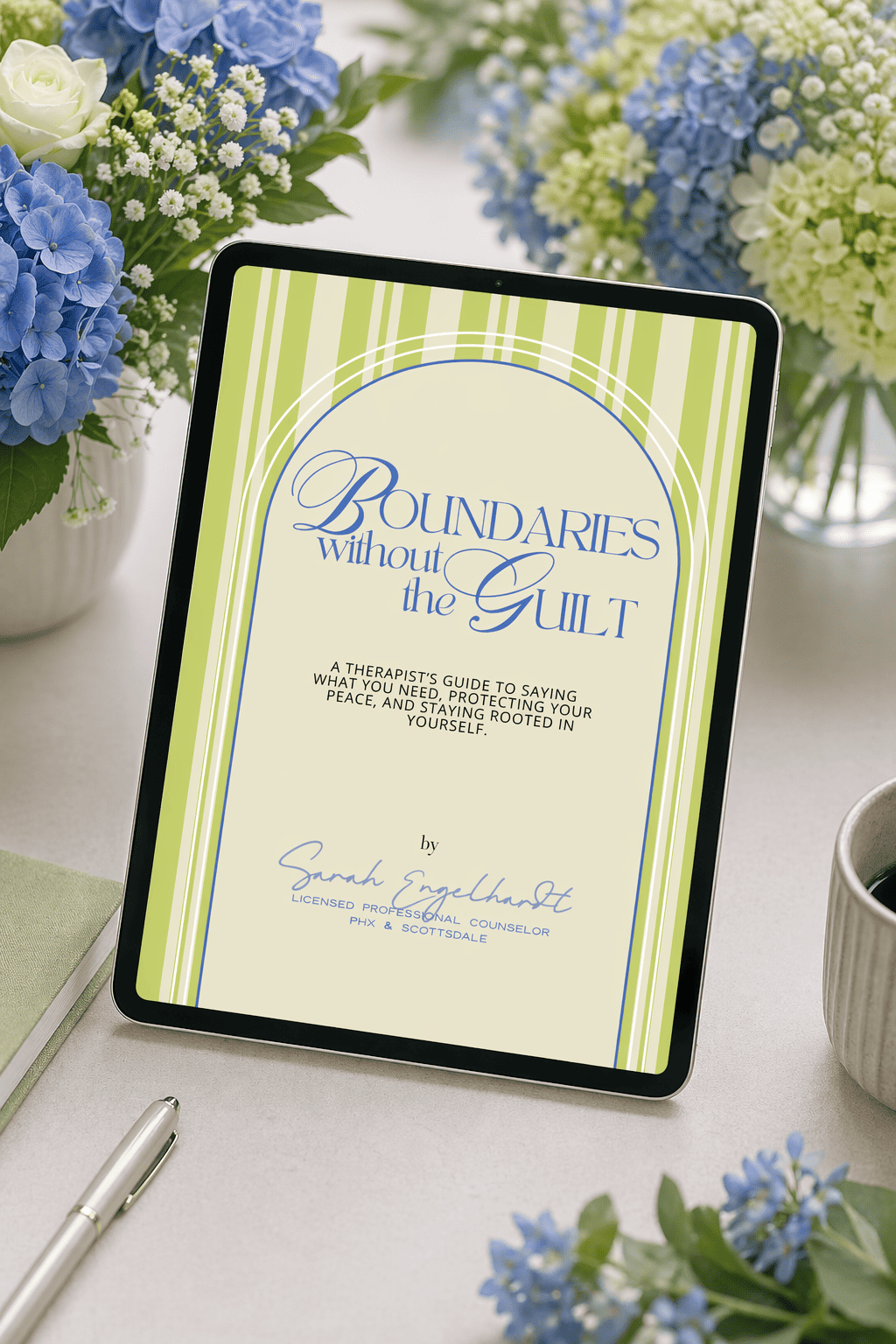
Recognizing patterns like these is one thing. Learning how to hold a boundary around them without spiraling into guilt is another. My free guide, Boundaries Without the Guilt, walks through why boundaries feel so hard in relationships like this, and how to start setting them in a way that feels steady, honest, and true to you.
If you're ready to talk through what you're noticing with someone who can help you make sense of it, I'd love to sit down with you.
